
The Quick Answer
Yes, for many homes, especially in Washington, DC. The 30% federal residential solar tax credit ended for systems installed after December 31, 2025. But DC’s solar renewable energy credits (SRECs) are among the most valuable in the country, and DC still offers full retail net metering, so DC homeowners can still earn strong returns without the federal credit.
In Maryland, the math is tighter but still works for many homes thanks to net metering, SRECs, a state sales tax exemption and some county property tax exemptions. Timing matters: Maryland’s current net metering program is scheduled to close to new customers on July 1, 2027, so homeowners who want today’s terms should not wait too long.
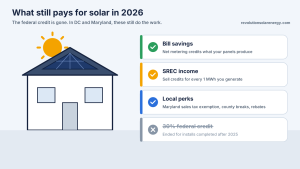
What Changed With the Federal Solar Tax Credit?
For years, the biggest incentive for home solar was the federal Residential Clean Energy Credit (Section 25D), worth 30% of a system’s cost. The 2025 federal budget law (Public Law 119-21) ended it. According to the Congressional Research Service:
- The credit doesn’t apply to expenditures made after December 31, 2025.
- An expenditure counts as “made” when installation is completed, not when you sign a contract or pay a deposit. A system started in 2025 but finished in 2026 does not qualify.
- Homeowners who qualified for a 2025 installation can still carry forward unused credit to future tax years.
That’s a real loss. On a $25,000 system, the credit was worth $7,500. Some solar companies have also not updated their marketing, so be cautious if anyone still promises a 30% federal tax credit on a new home system.
But the federal credit was never the only reason solar paid off in the DMV. DC and Maryland both have their own incentives, and in DC especially, those are large enough to carry a project on their own.
Why Solar Still Pays Off in Washington, DC
SRECs: DC’s biggest solar incentive
Every 1,000 kilowatt-hours (1 megawatt-hour) your system produces earns one solar renewable energy credit, or SREC. Utilities and electricity suppliers buy SRECs to meet DC’s renewable energy requirements, and you can sell yours through a broker or aggregator.
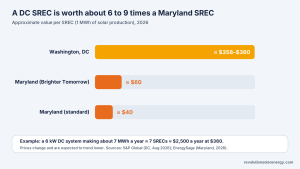
DC SRECs are worth far more than in most states. In August 2026, S&P Global Commodity Insights assessed DC SRECs at about $358 to $360 each. As a rough example, a 6 kW rooftop system producing around 7 MWh a year could earn about $2,500 a year in SRECs at that price, on top of what it saves on your electric bill.
Two cautions. First, prices are trending down. The same report notes DC has more solar than its targets require, and the penalty price that sets the ceiling for SRECs is scheduled to fall from $460 per MWh for 2025 to $360 by 2030. Second, SREC income isn’t guaranteed. Some brokers offer fixed multi-year contracts that trade a lower price for certainty.
Net metering at full retail value
In DC, your solar system’s production is credited against your electricity use each month. According to Solar United Neighbors, excess generation is credited at the full retail rate, unused credits roll over month to month indefinitely, and systems can be sized up to 200% of your usage.
Other DC considerations
- Row houses with limited roof space can add capacity with solar rooftop decks or solar pergolas.
- In some neighborhoods, Pepco may require grid upgrades before approving a new system. A local installer can tell you early if that’s likely on your block.
What Do Maryland Homeowners Still Get?
Maryland’s incentives are smaller than DC’s, but they add up, and one deadline makes 2026 an important year to decide.
Net metering, with a 2027 deadline
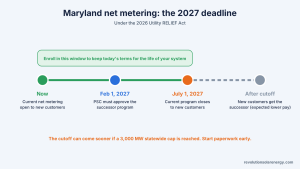
Maryland’s net metering credits your solar production against your electric use. Under the 2026 Utility RELIEF Act, the current program is scheduled to close to new customers on July 1, 2027, or sooner if a 3,000 MW statewide cap is reached. A successor program is expected to pay less, according to Gordon Feinblatt’s summary of the law and EnergySage.
Customers enrolled before the cutoff are expected to keep today’s terms for the life of their system, as long as they don’t significantly expand or replace it. The exact rules for what counts as enrolled are still being finalized, so starting interconnection paperwork in 2026 or early 2027 is the safest approach.
SRECs
Maryland SRECs are worth much less than DC’s. EnergySage reported 2026 prices around $40 per SREC, with Brighter Tomorrow Act SRECs for the first 300 MW of small residential systems around $60. Prices are expected to keep falling as the state’s penalty price drops.
Tax exemptions and rebates
- Sales tax: Qualifying residential solar systems are exempt from Maryland’s 6% sales tax.
- Property tax: Some counties exempt the value solar adds to your home. Check your county.
- Maryland Solar Access Program: Rebates for income-eligible households, through the Maryland Energy Administration.
- Batteries: The state’s Residential Energy Storage program offers up to $5,000 for home batteries, first-come, first-served, with a reservation required before installation.
DC vs. Maryland Solar Incentives at a Glance
| Incentive | Washington, DC | Maryland |
|---|---|---|
| Federal 30% tax credit (25D) | Ended for installs completed after Dec 31, 2025 | Ended for installs completed after Dec 31, 2025 |
| SREC value (2026) | About $358–$360 each | About $40; about $60 for Brighter Tomorrow SRECs |
| Net metering | Full retail credit, indefinite rollover | Available; current program closes to new customers July 1, 2027 |
| Sales tax | Check current DC rules | Residential solar exempt from the 6% state sales tax |
| Property tax | Check current DC rules | Some counties exempt solar’s added value |
| Income-based help | Ask about DC programs for income-qualified households | Maryland Solar Access Program rebates |
| Battery incentives | Ask your installer | Up to $5,000 through the state storage program |
The takeaway: in DC, SRECs alone can return a large share of a system’s cost over time. In Maryland, solar still saves money, but the decision depends more on your electric bill, roof and timing, and locking in today’s net metering before July 2027 is a key part of the value.
How Do I Know If Solar Makes Sense for My Home?
Solar tends to pay off best when most of these are true:
- Your roof gets good sun. South, east or west-facing roof areas with little shade from trees or neighboring buildings are ideal. Flat row house roofs often work well too.
- Your roof has years of life left. Replacing a roof after panels go up means removing and reinstalling them. If your roof is near the end of its life, plan both projects together.
- Your electric bill is meaningful. The more electricity you buy, the more solar can offset. Homes adding a heat pump or an electric vehicle often see the biggest benefit.
- You plan to stay a while. Solar’s savings build over many years, though solar can also add to your home’s value when you sell.
- You live in DC, or you’re in Maryland and can enroll before July 1, 2027. That’s when incentives are strongest.
What to ask for in a quote
A good solar proposal for a DC or Maryland home should spell out:
- Expected yearly production in kilowatt-hours, based on your roof’s actual shading.
- Estimated bill savings, using your real utility rates.
- SREC income assumptions and the price used.
- Total cost with no federal tax credit included.
- Equipment brands, warranties and who handles permits and utility interconnection.

If a quote still subtracts a 30% federal tax credit for a home system installed in 2026, ask why.
How Can I Make the Numbers Work Without the Federal Credit?
- Size the system to your real usage. An oversized system costs more without adding much value, while a well-sized one maximizes bill savings and SRECs.
- Pair solar with electrification. If you’re switching to a heat pump or buying an electric car, your electricity use rises, and solar offsets more of it.
- Compare financing options. Paying cash gives the best long-term return. A solar loan can let you start saving with little or no money down. Ask about financing options and compare the monthly payment with your expected bill savings.
- Ask about leases and power purchase agreements. With these, a third party owns the system and you pay for the power, often at a set rate below the utility’s. Your installer can explain whether one would cost you less than owning.
- Decide how to handle SRECs. In DC, a fixed-price SREC contract trades some upside for predictable income, which some lenders and homeowners prefer.
- Consider a battery for backup. A solar battery keeps essentials running during outages. In Maryland, the state storage program can help with the cost.
- Move before deadlines. In Maryland, the July 1, 2027 net metering cutoff is the big one. Permits and utility approval take time, so start early.
Frequently Asked Questions
Is the 30% solar tax credit still available in 2026?
No, not for home systems. The federal Residential Clean Energy Credit ended for systems whose installation was completed after December 31, 2025. Systems finished in 2025 can still carry forward any unused credit.
Is solar worth it in Washington, DC without the tax credit?
For many homes, yes. DC SRECs were worth about $358 to $360 each in mid-2026, among the highest values in the country, and DC credits excess solar at the full retail rate. Together, those can produce strong returns without the federal credit.
Is solar worth it in Maryland in 2026?
It can be, especially for homes with good sun and higher electric bills. Maryland offers net metering, SRECs and a sales tax exemption. Enrolling before the current net metering program closes to new customers on July 1, 2027 is an important part of the value.
What is an SREC worth in DC?
About $358 to $360 per SREC in August 2026, according to S&P Global. Each SREC represents 1 megawatt-hour of solar production. Prices are expected to trend lower over time.
What happens to Maryland net metering in 2027?
Under the 2026 Utility RELIEF Act, the current net metering program is scheduled to close to new customers on July 1, 2027, or sooner if a statewide cap is reached. A successor program is expected to pay less. Customers enrolled before the cutoff are expected to keep current terms.
How long does it take to install solar in DC?
Timelines depend on permits and utility approval. Revolution Solar handles the permitting and paperwork and can often complete installation in under eight weeks.
Can I get solar on a row house?
Yes. Flat row house roofs often work well, and solar rooftop decks or pergolas can add space for panels.
About Revolution Solar
Revolution Solar is a solar installer based at 1328 Florida Ave NW in Washington, DC, serving homes and businesses across DC and Maryland, including Prince George’s, Montgomery, Howard and Baltimore counties. We design and install rooftop solar, ground mounts, solar rooftop decks and pergolas, battery storage and commercial systems, and we’ve completed hundreds of installations in DC and nearby areas.
We handle permits, utility paperwork and SREC registration, hold an A+ rating with the Better Business Bureau, and offer financing options including programs with no money down.
Want to know what solar would earn on your roof without the federal credit? Call (202) 827-6527 or request a free quote.
Sources
- Congressional Research Service: Expiration and carryforward rules for the Residential Clean Energy Credit
- S&P Global Commodity Insights: DC SREC prices fall as oversupply, lower ACPs weigh on forward market
- Solar United Neighbors: Net metering in DC
- Gordon Feinblatt: Maryland’s Utility RELIEF Act
- EnergySage: Maryland solar rebates and incentives