
What Is an SREC, and Why Are DC’s So Valuable?
An SREC, or solar renewable energy credit, is a certificate that proves 1 megawatt-hour of electricity was generated by solar. It’s separate from the electricity itself. Your panels power your home and earn net metering credits on your bill, and they also create SRECs you can sell on top of that.
DC SRECs are valuable because of the District’s renewable portfolio standard. Electricity suppliers serving DC must buy a growing share of their power from renewable sources, including a solar-specific requirement that rises to 10% of the District’s electricity by 2041. Suppliers that come up short pay a penalty called the solar alternative compliance payment (ACP), so they’d rather buy SRECs from homeowners for less than that penalty.
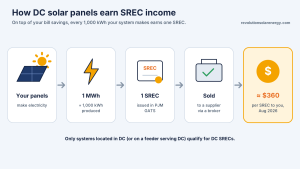
Two more things make DC’s market unusual:
- Only local systems qualify. According to the DC Public Service Commission, systems must be located in the District or served by a distribution feeder that serves the District. Out-of-District solar certified before 2011 is being phased out.
- The penalty price is high. S&P Global reports the solar ACP was $460 per MWh for 2025, scheduled to fall to $360 by 2030. That ceiling keeps DC SREC prices far above most states.
How Do I Sell SRECs in DC, Step by Step?
The process follows the steps in the DC PSC’s renewable generator fact sheet. Your installer or an SREC aggregator can do most of it for you.
- Install and interconnect your system. Your solar system must be installed, inspected and approved by Pepco before it starts producing credits you can sell.
- Apply for certification with the DC Public Service Commission. Applications are filed through the PSC’s online RPS portal. Solar applications must include as-built construction drawings. If someone else, such as your installer or aggregator, will register and report for you, include a document authorizing them.
- Receive your certification number. If approved, the PSC issues an order with a certification number. That number is what lets your SRECs count toward DC’s requirement.
- Register with PJM-EIS GATS. The Generation Attribute Tracking System (GATS), run by PJM Environmental Information Services, creates and tracks your SRECs. A third party can handle the registration.
- Report your production. Your system’s output is reported to GATS, usually monthly, often automatically through a production meter or your aggregator. GATS issues one SREC per 1,000 kWh.
- Sell your SRECs. Choose how to sell (see below): on the spot market through a broker, through a multi-year fixed-price contract, or sometimes as an upfront payment for future SRECs.
- Get paid. Payment typically arrives after each SREC is issued and transferred to the buyer.
Timing tip: The PSC notes that applications spike each December and January, so apply as soon as your system is installed to avoid delays.
How Much Can I Earn From SRECs in DC?
Your SREC income depends on two things: how much electricity your system produces, and the price you sell at. As a rough rule, a well-placed rooftop system in DC produces somewhere around 1.1 to 1.3 MWh per kilowatt of capacity each year, depending on orientation and shading.
At the August 2026 price of about $360 per SREC, that works out roughly like this:
| System size | Estimated yearly production | Estimated SRECs per year | Estimated yearly SREC income at $360 |
|---|---|---|---|
| 4 kW | About 5 MWh | About 5 | About $1,800 |
| 6 kW | About 7 MWh | About 7 | About $2,500 |
| 8 kW | About 10 MWh | About 10 | About $3,600 |
| 10 kW | About 12 MWh | About 12 | About $4,300 |
These are estimates for illustration. Your installer’s proposal should show expected production for your actual roof, and actual SREC prices will change over time. SRECs are issued only for whole megawatt-hours, so smaller systems may take more than a month to generate each one.
What Are My Options for Selling DC SRECs?
| Option | How it works | Upside | Trade-off | Best for |
|---|---|---|---|---|
| Spot market (through a broker or aggregator) | Sell each SREC at the current market price as it’s issued | Captures today’s high prices | Income falls if prices drop | Homeowners comfortable with some risk |
| Fixed-price contract | Agree to sell your SRECs at a set price for a set number of years | Predictable income you can plan around | Usually a lower price than the spot market | Homeowners who want certainty or are budgeting a loan payment |
| Upfront payment | Sell several years of future SRECs for a lump sum at installation | Lowers your out-of-pocket cost right away | Usually the lowest total value; you give up future SREC income | Homeowners who want to reduce the upfront cost |
Whichever you choose, read the contract carefully. Look for the price per SREC, the contract length, any fees or commissions, who handles GATS reporting, and what happens if you sell your home.
Many homeowners split the difference: they lock in a fixed price for part of their SRECs or for the first few years, and sell the rest on the spot market.
Will DC SREC Prices Stay This High?
Probably not forever, and it’s smart to plan for that. In an August 2026 report, S&P Global Commodity Insights noted three pressures on prices:
- Oversupply. DC’s eligible solar capacity reached 373.7 MW at the end of 2025, above the 293 MW target, which tends to push prices down.
- A falling price ceiling. The solar ACP, which effectively caps SREC prices, is scheduled to drop from $460 per MWh for 2025 to $360 by 2030.
- Policy uncertainty in other states. Changes in New Jersey and Massachusetts have made markets more cautious about long-term solar requirements, although S&P reported no active proposal in DC to change its solar requirement.
Even so, forward prices for 2025 through 2027 SRECs were still trading near $360 in August 2026, and DC remains one of the strongest SREC markets in the country. The practical takeaway: count SREC income as a big benefit, but don’t build your budget on today’s spot price lasting for decades. A fixed-price contract for some of your SRECs is a reasonable hedge.
What Mistakes Should I Avoid?
- Waiting to apply. You can’t sell SRECs until your system is certified and registered. Every month of delay is income you may not recover, so apply as soon as your system is interconnected.
- Signing the first SREC offer you get. Compare at least two or three buyers. Look at the price per SREC, the term, fees and who handles reporting.
- Locking in everything for too long at a low price. Long fixed contracts give certainty, but make sure the price is fair compared with current market levels.
- Forgetting about SRECs when you sell your home. SREC rights may transfer with the system or stay with a contract buyer. Decide how they’ll be handled in your sale agreement.
- Ignoring production problems. If your system stops producing, so do your SRECs. Monitor output monthly and request maintenance quickly.
- Overlooking taxes. SREC income may be taxable. Ask a tax professional how it applies to you.
A quick way to get it right
Choose an installer that handles PSC certification, GATS registration and SREC sales as part of the project. That way your system starts earning SRECs as soon as it’s eligible, and you have one point of contact if anything goes wrong.
Frequently Asked Questions
How much is a DC SREC worth in 2026?
About $358 to $360 per SREC as of August 2026, according to S&P Global Commodity Insights. Prices change over time and are expected to trend lower as more solar comes online and the penalty price ceiling falls.
How many SRECs does a solar system produce?
One SREC for every 1,000 kWh (1 MWh) produced. A typical 6 kW rooftop system in DC might produce around 7 SRECs a year, depending on orientation and shading.
Who buys SRECs in DC?
Electricity suppliers serving DC buy SRECs to meet the District’s solar requirement. Homeowners usually sell through SREC brokers, aggregators or contract buyers rather than directly to suppliers.
How do I get my solar system certified for DC SRECs?
Apply to the DC Public Service Commission through its online RPS portal, including your system’s as-built drawings. Once approved, you receive a certification number, and the system is then registered in PJM-EIS GATS so SRECs can be issued.
Can a Maryland solar system sell DC SRECs?
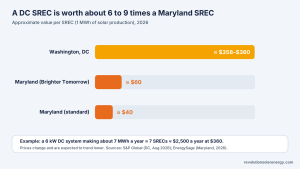
Generally no. DC requires systems to be located in the District or served by a distribution feeder that serves the District. Maryland systems sell into Maryland’s SREC market, where prices are much lower.
Should I sell SRECs on the spot market or sign a contract?
Spot sales capture current high prices but carry risk if prices fall. Fixed contracts give predictable income at a somewhat lower price. Many homeowners use a mix.
Does Revolution Solar help with SRECs?
Yes. Revolution Solar helps DC customers register their systems and sell their SRECs. Learn more on our SREC page.
About Revolution Solar
Revolution Solar is a solar installer based at 1328 Florida Ave NW in Washington, DC, serving homes and businesses across DC and Maryland. We design and install rooftop solar, ground mounts, solar rooftop decks and pergolas, battery storage and commercial systems, and we’ve completed hundreds of installations in DC and nearby areas.
We handle permits and utility paperwork and help DC customers get certified and sell their SRECs, so your system starts earning as soon as it’s eligible. We hold an A+ rating with the Better Business Bureau and offer financing options, including programs with no money down.
Want to know how many SRECs your roof could earn? Call (202) 827-6527 or request a free quote.